 |
Electronic Components Datasheet Search |
|
|
Electronic Components Datasheet Search |
|
The question interval is too short.
Please try again in a few seconds.

Hello, Please ask a question about MT7697DIN Datasheet
# Example questions:
➢ Explain the function of the eldo (efuse ldo) and when it is utilized.
➢ What are the key differences between the 'n9 sleep' and 'pmu sleep' power states, and what conditions would lead the mt7697d to enter each state?
➢ Describe the different power domains within the mt7697d and explain how they contribute to power saving.
| Part No. | MT7697DIN |
| Manufacturer | ETC2 |
| Size | 1Mb |
| Pages | 84 pages |
| Description | Internet-of-Things Wireless Connectivity |




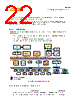


1. Overall Purpose & Device:
️· The document describes the power management features of the MT7697D, a chip designed for IoT and wireless applications. It focuses on power states and efficiency.
2. Power Management Architecture
️· Multiple Power Domains: The chip is divided into several power domains (TOP_AON, TOP_OFF(N9), WF_OFF, BT_OFF, CM4_SYS) that can be independently controlled to reduce power consumption.
️· Power States: A variety of power states are available, ranging from fully active (full operation) to deep sleep, each with associated power consumption levels.
️· Sleep Mode Controllers: Two controllers manage power states – one for the N9 (WiFi/Bluetooth processor) and one for the CM4 (Cortex-M4 microcontroller).
️· PMU (Power Management Unit): The PMU regulates voltages and manages sleep modes, including gating power to different domains. It also includes LDOs (Low Dropout Regulators) for various voltage rails.
️· Efuse LDO: Provides 2.5V for programming the internal Efuse macro.
3. Key Power States & Their Characteristics:
CM4 (Cortex-M4) Subsystem:
️· Active: Full operation, highest power consumption.
️· Standby: Reduced power, but still retaining some operating state.
️· Sleep: Significantly reduced power, using the 32kHz clock.
️· PMU Sleep: Deepest sleep state, power gated domains.
N9 (WiFi/Bluetooth) Subsystem:
️· Active: Full WiFi/Bluetooth operation, highest power.
️· Idle: Maintaining WiFi functionality (e.g., beacon listening).
️· Standby: Reduced power, retaining state.
️· Sleep: Deep sleep with 32kHz clock, can wake on various events.
️· PMU Sleep: Deepest sleep state, power gated domains.
4. Power Saving Techniques:
️· Independent Power Domain Control: Allows selective power gating of modules not in use.
️· Sleep Modes: Deep sleep states significantly reduce power consumption when the chip is idle.
️· Clock Gating: Disabling clocks to inactive modules to minimize power usage.
️· PMU Sleep: The deepest power saving mode, completely isolating certain domains.
5. Voltage Regulation:
️· The PMU uses a combination of switching regulators and LDOs to generate various voltage rails for the different chip functions.
1. Overall Purpose & Device:
️· The document describes the power management features of the MT7697D, a chip designed for IoT and wireless applications. It focuses on power states and efficiency.
2. Power Management Architecture
️· Multiple Power Domains: The chip is divided into several power domains (TOP_AON, TOP_OFF(N9), WF_OFF, BT_OFF, CM4_SYS) that can be independently controlled to reduce power consumption.
️· Power States: A variety of power states are available, ranging from fully active (full operation) to deep sleep, each with associated power consumption levels.
️· Sleep Mode Controllers: Two controllers manage power states – one for the N9 (WiFi/Bluetooth processor) and one for the CM4 (Cortex-M4 microcontroller).
️· PMU (Power Management Unit): The PMU regulates voltages and manages sleep modes, including gating power to different domains. It also includes LDOs (Low Dropout Regulators) for various voltage rails.
️· Efuse LDO: Provides 2.5V for programming the internal Efuse macro.
3. Key Power States & Their Characteristics:
CM4 (Cortex-M4) Subsystem:
️· Active: Full operation, highest power consumption.
️· Standby: Reduced power, but still retaining some operating state.
️· Sleep: Significantly reduced power, using the 32kHz clock.
️· PMU Sleep: Deepest sleep state, power gated domains.
N9 (WiFi/Bluetooth) Subsystem:
️· Active: Full WiFi/Bluetooth operation, highest power.
️· Idle: Maintaining WiFi functionality (e.g., beacon listening).
️· Standby: Reduced power, retaining state.
️· Sleep: Deep sleep with 32kHz clock, can wake on various events.
️· PMU Sleep: Deepest sleep state, power gated domains.
4. Power Saving Techniques:
️· Independent Power Domain Control: Allows selective power gating of modules not in use.
️· Sleep Modes: Deep sleep states significantly reduce power consumption when the chip is idle.
️· Clock Gating: Disabling clocks to inactive modules to minimize power usage.
️· PMU Sleep: The deepest power saving mode, completely isolating certain domains.
5. Voltage Regulation:
️· The PMU uses a combination of switching regulators and LDOs to generate various voltage rails for the different chip functions.
| Part No. | MT7697DIN |
| Manufacturer | ETC2 |
| Size | 1Mb |
| Pages | 84 pages |
| Description | Internet-of-Things Wireless Connectivity |
| Does ALLDATASHEET help your business so far? [ DONATE ] |
About Alldatasheet | Advertisement | Contact us | Privacy Policy | Link to Datasheet | Link Exchange | Manufacturer List All Rights Reserved©Alldatasheet.com |
| Russian : Alldatasheetru.com | Korean : Alldatasheet.co.kr | Spanish : Alldatasheet.es | French : Alldatasheet.fr | Italian : Alldatasheetit.com Portuguese : Alldatasheetpt.com | Polish : Alldatasheet.pl | Vietnamese : Alldatasheet.vn Indian : Alldatasheet.in | Mexican : Alldatasheet.com.mx | British : Alldatasheet.co.uk | New Zealand : Alldatasheet.co.nz |
|
Family Site : ic2ic.com |
icmetro.com |
 British ▼
  English
 Chinese
 German
 Japanese
 Russian
 Korean
 Spanish
 French
 Italian
 Portuguese
 Polish
 Vietnamese
 Indian
 Mexican
 New Zealand