 |
Electronic Components Datasheet Search |
|
|
Electronic Components Datasheet Search |
|
The question interval is too short.
Please try again in a few seconds.

Hello, Please ask a question about AMIS-42671 Datasheet
# Example questions:
➢ What is a critical consideration regarding moisture sensitivity for surface mount packages, and what phenomenon can occur if this is not addressed?
➢ What is the typical peak temperature range for reflow soldering, as specified in the document?
➢ The document details conditions for wave soldering. what specific requirement exists for the placement of hlqfp, hsqfp, hsop, htssop, and sms packages if wave soldering is attempted?
| Part No. | AMIS-42671 |
| Manufacturer | AMI |
| Size | 546 Kbytes |
| Pages | 12 pages |
| Description | High-Speed CAN Transceiver |


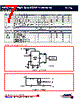
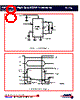

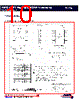


Document Overview: This is a data sheet and technical reference for the AMIS-42671 High-Speed CAN Transceiver. It covers electrical characteristics, timing, measurement setups, and soldering guidelines. The document is intended for engineers designing systems using this CAN transceiver.
1. Core Function: CAN Transceiver
️· The AMIS-42671 is a CAN (Controller Area Network) transceiver. CAN is a communication protocol commonly used in automotive, industrial, and other applications where reliable data transfer is needed between microcontrollers or devices.
️· Key Features Mentioned (Implied): High-speed communication, robust operation.
2. Electrical Characteristics (Highly Technical - Key Points Only)
️· Supply Voltage: Operates with a specific voltage range (not explicitly stated, but implied through the given characteristics).
️· Input Voltages & Leakage Currents: Provides specific limits and values for input voltages and leakage currents to ensure proper circuit operation and prevent damage.
️· Common-Mode Voltage Handling: Specifies how the transceiver can handle varying voltage levels on the CAN bus.
️· Power-on Reset (POR): Defines the voltage level required for the device to reset during power-up.
️· Thermal Shutdown: Specifies the temperature at which the device shuts down to prevent overheating.
3. Timing Characteristics (Critical for Correct Communication)
️· Delay Times (td): Describes the time delays in data transmission and reception. These delays impact the overall system timing. Key values listed include `td(TxD-BUSon)`, `td(TxD-BUSoff)`, `td(BUSon-RxD)`, `td(BUSoff-RxD)`, `tpd(rec-dom)` and `td(dom-rec)`.
️· Propagation Delays: Delays between input (TxD) and output (BUS) signals, and vice versa. These need to be considered when designing the overall system.
4. Measurement Set-ups
️· Describes the specific test conditions used to determine the values given in the electrical characteristics and timing sections. This is for engineers to understand the context of the data.
5. Soldering Guidelines
️· Moisture Sensitivity: Highlights the importance of handling surface-mount devices (SMDs) to avoid moisture-related damage ("popcorn effect").
️· Soldering Methods: Discusses various soldering methods:
- Reflow Soldering: Preferred method for most SMD packages. Requires solder paste application.
- Wave Soldering: Not recommended for most smaller SMD packages. Specific conditions apply if wave soldering is used.
- Manual Soldering: Provides guidance for manual soldering procedures.
️· Package Specifics: Provides recommendations on soldering angles and solder thief placement depending on package type and lead pitch.
Key Takeaways for Engineers:
️· Timing is Critical: Pay close attention to the timing characteristics when designing systems.
️· Soldering is Important: Follow the soldering guidelines carefully to prevent damage and ensure proper connections.
️· Moisture Sensitivity: Handle devices properly to prevent moisture-related problems.
️· Refer to Data Handbook: Consult the “Data Handbook IC26” for more detailed information on IC packaging and soldering.
Document Overview: This is a data sheet and technical reference for the AMIS-42671 High-Speed CAN Transceiver. It covers electrical characteristics, timing, measurement setups, and soldering guidelines. The document is intended for engineers designing systems using this CAN transceiver.
1. Core Function: CAN Transceiver
️· The AMIS-42671 is a CAN (Controller Area Network) transceiver. CAN is a communication protocol commonly used in automotive, industrial, and other applications where reliable data transfer is needed between microcontrollers or devices.
️· Key Features Mentioned (Implied): High-speed communication, robust operation.
2. Electrical Characteristics (Highly Technical - Key Points Only)
️· Supply Voltage: Operates with a specific voltage range (not explicitly stated, but implied through the given characteristics).
️· Input Voltages & Leakage Currents: Provides specific limits and values for input voltages and leakage currents to ensure proper circuit operation and prevent damage.
️· Common-Mode Voltage Handling: Specifies how the transceiver can handle varying voltage levels on the CAN bus.
️· Power-on Reset (POR): Defines the voltage level required for the device to reset during power-up.
️· Thermal Shutdown: Specifies the temperature at which the device shuts down to prevent overheating.
3. Timing Characteristics (Critical for Correct Communication)
️· Delay Times (td): Describes the time delays in data transmission and reception. These delays impact the overall system timing. Key values listed include `td(TxD-BUSon)`, `td(TxD-BUSoff)`, `td(BUSon-RxD)`, `td(BUSoff-RxD)`, `tpd(rec-dom)` and `td(dom-rec)`.
️· Propagation Delays: Delays between input (TxD) and output (BUS) signals, and vice versa. These need to be considered when designing the overall system.
4. Measurement Set-ups
️· Describes the specific test conditions used to determine the values given in the electrical characteristics and timing sections. This is for engineers to understand the context of the data.
5. Soldering Guidelines
️· Moisture Sensitivity: Highlights the importance of handling surface-mount devices (SMDs) to avoid moisture-related damage ("popcorn effect").
️· Soldering Methods: Discusses various soldering methods:
- Reflow Soldering: Preferred method for most SMD packages. Requires solder paste application.
- Wave Soldering: Not recommended for most smaller SMD packages. Specific conditions apply if wave soldering is used.
- Manual Soldering: Provides guidance for manual soldering procedures.
️· Package Specifics: Provides recommendations on soldering angles and solder thief placement depending on package type and lead pitch.
Key Takeaways for Engineers:
️· Timing is Critical: Pay close attention to the timing characteristics when designing systems.
️· Soldering is Important: Follow the soldering guidelines carefully to prevent damage and ensure proper connections.
️· Moisture Sensitivity: Handle devices properly to prevent moisture-related problems.
️· Refer to Data Handbook: Consult the “Data Handbook IC26” for more detailed information on IC packaging and soldering.
| Part No. | AMIS-42671 |
| Manufacturer | AMI |
| Size | 546 Kbytes |
| Pages | 12 pages |
| Description | High-Speed CAN Transceiver |
| Does ALLDATASHEET help your business so far? [ DONATE ] |
About Alldatasheet | Advertisement | Contact us | Privacy Policy | Link to Datasheet | Link Exchange | Manufacturer List All Rights Reserved©Alldatasheet.com |
| Russian : Alldatasheetru.com | Korean : Alldatasheet.co.kr | Spanish : Alldatasheet.es | French : Alldatasheet.fr | Italian : Alldatasheetit.com Portuguese : Alldatasheetpt.com | Polish : Alldatasheet.pl | Vietnamese : Alldatasheet.vn Indian : Alldatasheet.in | Mexican : Alldatasheet.com.mx | British : Alldatasheet.co.uk | New Zealand : Alldatasheet.co.nz |
|
Family Site : ic2ic.com |
icmetro.com |
 British ▼
  English
 Chinese
 German
 Japanese
 Russian
 Korean
 Spanish
 French
 Italian
 Portuguese
 Polish
 Vietnamese
 Indian
 Mexican
 New Zealand