 |
Electronic Components Datasheet Search |
|
|
Electronic Components Datasheet Search |
|
The question interval is too short.
Please try again in a few seconds.

Hello, Please ask a question about PXI-5441 Datasheet
# Example questions:
➢ What are the key differences in amplitude range between the main output path and the direct path of the ni 5751 arbitrary waveform generator?
➢ How does increasing the onboard memory option (from 32mb to 256mb or 512mb) affect the maximum waveform playtime at a sample rate of 100 ms/s with osp disabled?
➢ What certifications and compliances does the ni 5751 meet?
| Part No. | PXI-5441 |
| Manufacturer | NI |
| Size | 289 Kbytes |
| Pages | 7 pages |
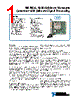
| Description | 100 MS/s, 16-bit Arbitrary Waveform Generator with Onboard Signal Processing |





1. Overview
This document details the specifications for a National Instruments (NI) arbitrary waveform generator, likely a module designed for use within a PXI (PCI eXtensions for Instrumentation) system. It allows for precise generation of electrical signals, including arbitrary waveforms, standard waveforms (sine, square, etc.), and sequence-based signals. It’s intended for applications needing high-precision signal generation.
2. Key Features
️· Arbitrary Waveform Generation: Generates custom waveforms beyond standard shapes.
️· Sequence Mode: Combines multiple waveform segments into complex sequences.
️· Standard Waveform Support: Includes common waveforms like sine, square, triangle, ramp, and noise.
️· Memory Options: Available with 32 MB, 32MB, 256 MB, or 512 MB of onboard memory.
️· High-Speed Digital I/O: 16 LVDS data lines for communication.
️· Flexible Triggering: Supports various triggering sources and modes (Single, Continuous, Stepped, Burst).
️· PXI Integration: Designed for use within a PXI chassis.
️· Self-Calibration: Automatic calibration of DC gain and offset.
3. Performance Specifications
This is the most detailed section and is broken down into subsections.
️· Sample Rate & Resolution: Maximum sample rate of 100 MS/s (MegaSamples per second).
️· Amplitude Range:
- Main Output Path: 12 Vpp (peak-to-peak) to 5.64 mVpp (can be scaled)
- Direct Path: 1 Vpp to 0.707 Vpp (50 Ω load)
️· Accuracy:
- DC Accuracy: ± 0.4% of Amplitude ± 0.05% of Offset ± 1 mV
- AC Amplitude Accuracy: ± 1.0% of Amplitude ± 1 mV at 50 kHz
️· Signal Quality:
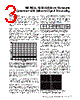
- SINAD (Signal-to-Noise and Distortion): Ranges from 60dB to 66dB, depending on path and frequency (see table in datasheet).
- Spurious Free Dynamic Range: Generally between -71 dBc and -89 dBFS (peak-to-peak voltage).
️· Frequency Characteristics:
- Maximum Frequencies for Standard Waveforms: Sine (43 MHz), Square (25 MHz), Triangle/Ramp (5 MHz), Noise (5 MHz)
️· Phase Noise & Jitter:
- System Phase Noise: Typically -137 dBc/Hz (10 kHz offset) for Divide-by-N.
- System Output Jitter: < 4.0 ps rms.
️· Digital Output: 16 LVDS data lines, ANSI/TIA/EIA-644 compliant.
️· Triggering: Various trigger sources (PFI, PXI_TRIG, software, immediate) and modes.
️· Memory Utilization: Varies depending on memory size; the datasheet gives examples in terms of waveforms and segments possible.
4. Environmental & Compliance
️· Operating Temperature: 0°C to +55°C
️· Storage Temperature: -25°C to +85°C
️· Humidity: 10% to 90%, non-condensing.
️· Compliance: CE Marked
5. Summary of Important Considerations
️· PXI Ecosystem: This device *requires* a PXI chassis and controller to function. It's not a standalone device.
️· Memory Capacity: The memory size is a critical factor in the complexity of waveforms and sequences that can be generated.
️· Amplitude Scaling: The amplitude ranges are adjustable and provide flexibility.
️· Signal Integrity: Pay attention to the SINAD and spurious free dynamic range values when considering signal quality for demanding applications.
️· Triggering: Carefully select triggering options to control waveform generation precisely.
️· Calibration: Periodic external calibration (every 2 years) is recommended to maintain accuracy.
️· Operating Conditions: The datasheet specifications are valid under the specified operating conditions, as noted throughout the document.
IMPORTANT NOTES & LIMITATIONS:
️· Datasheet Version: This information is based on the provided datasheet. Specifications can change over time. Always refer to the latest datasheet from NI’s website for the most accurate information.
️· Operating Conditions: The specifications are dependent on proper system setup, cabling, and power supply. The "specified operating conditions" listed in the datasheet are crucial.
️· Application Specifics: The performance in a real-world application may vary depending on the specific use case.
️· Complexity: Understanding and utilizing the full capabilities of this device requires a good understanding of PXI systems, signal generation principles, and NI’s software tools.
️· Abbreviations: Vpp (peak-to-peak), SINAD (Signal-to-Noise and Distortion), dBc (decibels relative to carrier), dBFS (decibels relative to full scale).
1. Overview
This document details the specifications for a National Instruments (NI) arbitrary waveform generator, likely a module designed for use within a PXI (PCI eXtensions for Instrumentation) system. It allows for precise generation of electrical signals, including arbitrary waveforms, standard waveforms (sine, square, etc.), and sequence-based signals. It’s intended for applications needing high-precision signal generation.
2. Key Features
️· Arbitrary Waveform Generation: Generates custom waveforms beyond standard shapes.
️· Sequence Mode: Combines multiple waveform segments into complex sequences.
️· Standard Waveform Support: Includes common waveforms like sine, square, triangle, ramp, and noise.
️· Memory Options: Available with 32 MB, 32MB, 256 MB, or 512 MB of onboard memory.
️· High-Speed Digital I/O: 16 LVDS data lines for communication.
️· Flexible Triggering: Supports various triggering sources and modes (Single, Continuous, Stepped, Burst).
️· PXI Integration: Designed for use within a PXI chassis.
️· Self-Calibration: Automatic calibration of DC gain and offset.
3. Performance Specifications
This is the most detailed section and is broken down into subsections.
️· Sample Rate & Resolution: Maximum sample rate of 100 MS/s (MegaSamples per second).
️· Amplitude Range:
- Main Output Path: 12 Vpp (peak-to-peak) to 5.64 mVpp (can be scaled)
- Direct Path: 1 Vpp to 0.707 Vpp (50 Ω load)
️· Accuracy:
- DC Accuracy: ± 0.4% of Amplitude ± 0.05% of Offset ± 1 mV
- AC Amplitude Accuracy: ± 1.0% of Amplitude ± 1 mV at 50 kHz
️· Signal Quality:
- SINAD (Signal-to-Noise and Distortion): Ranges from 60dB to 66dB, depending on path and frequency (see table in datasheet).
- Spurious Free Dynamic Range: Generally between -71 dBc and -89 dBFS (peak-to-peak voltage).
️· Frequency Characteristics:
- Maximum Frequencies for Standard Waveforms: Sine (43 MHz), Square (25 MHz), Triangle/Ramp (5 MHz), Noise (5 MHz)
️· Phase Noise & Jitter:
- System Phase Noise: Typically -137 dBc/Hz (10 kHz offset) for Divide-by-N.
- System Output Jitter: < 4.0 ps rms.
️· Digital Output: 16 LVDS data lines, ANSI/TIA/EIA-644 compliant.
️· Triggering: Various trigger sources (PFI, PXI_TRIG, software, immediate) and modes.
️· Memory Utilization: Varies depending on memory size; the datasheet gives examples in terms of waveforms and segments possible.
4. Environmental & Compliance
️· Operating Temperature: 0°C to +55°C
️· Storage Temperature: -25°C to +85°C
️· Humidity: 10% to 90%, non-condensing.
️· Compliance: CE Marked
5. Summary of Important Considerations
️· PXI Ecosystem: This device *requires* a PXI chassis and controller to function. It's not a standalone device.
️· Memory Capacity: The memory size is a critical factor in the complexity of waveforms and sequences that can be generated.
️· Amplitude Scaling: The amplitude ranges are adjustable and provide flexibility.
️· Signal Integrity: Pay attention to the SINAD and spurious free dynamic range values when considering signal quality for demanding applications.
️· Triggering: Carefully select triggering options to control waveform generation precisely.
️· Calibration: Periodic external calibration (every 2 years) is recommended to maintain accuracy.
️· Operating Conditions: The datasheet specifications are valid under the specified operating conditions, as noted throughout the document.
IMPORTANT NOTES & LIMITATIONS:
️· Datasheet Version: This information is based on the provided datasheet. Specifications can change over time. Always refer to the latest datasheet from NI’s website for the most accurate information.
️· Operating Conditions: The specifications are dependent on proper system setup, cabling, and power supply. The "specified operating conditions" listed in the datasheet are crucial.
️· Application Specifics: The performance in a real-world application may vary depending on the specific use case.
️· Complexity: Understanding and utilizing the full capabilities of this device requires a good understanding of PXI systems, signal generation principles, and NI’s software tools.
️· Abbreviations: Vpp (peak-to-peak), SINAD (Signal-to-Noise and Distortion), dBc (decibels relative to carrier), dBFS (decibels relative to full scale).
| Part No. | PXI-5441 |
| Manufacturer | NI |
| Size | 289 Kbytes |
| Pages | 7 pages |
| Description | 100 MS/s, 16-bit Arbitrary Waveform Generator with Onboard Signal Processing |
| Does ALLDATASHEET help your business so far? [ DONATE ] |
About Alldatasheet | Advertisement | Contact us | Privacy Policy | Link to Datasheet | Link Exchange | Manufacturer List All Rights Reserved©Alldatasheet.com |
| Russian : Alldatasheetru.com | Korean : Alldatasheet.co.kr | Spanish : Alldatasheet.es | French : Alldatasheet.fr | Italian : Alldatasheetit.com Portuguese : Alldatasheetpt.com | Polish : Alldatasheet.pl | Vietnamese : Alldatasheet.vn Indian : Alldatasheet.in | Mexican : Alldatasheet.com.mx | British : Alldatasheet.co.uk | New Zealand : Alldatasheet.co.nz |
|
Family Site : ic2ic.com |
icmetro.com |
 British ▼
  English
 Chinese
 German
 Japanese
 Russian
 Korean
 Spanish
 French
 Italian
 Portuguese
 Polish
 Vietnamese
 Indian
 Mexican
 New Zealand