|
Electronic Components Datasheet Search |
|
|
Electronic Components Datasheet Search |
|
H8SX/1663R Datasheet(PDF) 1055 Page - Renesas Technology Corp |
|
|
|||||||||||||||||||||||||||||
H8SX/1663R Datasheet(HTML) 1055 Page - Renesas Technology Corp |
|
|
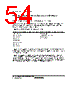
1055 / 1504 page  Section 20 USB Function Module (USB) Rev. 2.00 Sep. 24, 2008 Page 1023 of 1468 REJ09B0412-0200 20.7 Stall Operations 20.7.1 Overview This section describes stall operations in this module. There are two cases in which the USB function module stall function is used: • When the application forcibly stalls an endpoint for some reason • When a stall is performed automatically within the USB function module due to a USB specification violation The USB function module has internal status bits that hold the status (stall or non-stall) of each endpoint. When a transaction is sent from the host, the module references these internal status bits and determines whether to return a stall to the host. These bits cannot be cleared by the application; they must be cleared with a Clear Feature command from the host. However, the internal status bit for EP0 is automatically cleared only when the setup command is received. 20.7.2 Forcible Stall by Application The application uses the EPSTL register to issue a stall request for the USB function module. When the application wishes to stall a specific endpoint, it sets the corresponding bit in EPSTL (1- 1 in figure 20.20). The internal status bits are not changed at this time. When a transaction is sent from the host for the endpoint for which the EPSTL bit was set, the USB function module references the internal status bit, and if this is not set, references the corresponding bit in EPSTL (1-2 in figure 20.20). If the corresponding bit in EPSTL is set, the USB function module sets the internal status bit and returns a stall handshake to the host (1-3 in figure 20.20). If the corresponding bit in EPSTL is not set, the internal status bit is not changed and the transaction is accepted. Once an internal status bit is set, it remains set until cleared by a Clear Feature command from the host, without regard to the EPSTL register. Even after a bit is cleared by the Clear Feature command (3-1 in figure 20.20), the USB function module continues to return a stall handshake while the bit in EPSTL is set, since the internal status bit is set each time a transaction is executed for the corresponding endpoint (1-2 in figure 20.20). To clear a stall, therefore, it is necessary for the corresponding bit in EPSTL to be cleared by the application, and also for the internal status bit to be cleared with a Clear Feature command (2-1, 2-2, and 2-3 in figure 20.20). |
|
Link URL |
| Does ALLDATASHEET help your business so far? [ DONATE ] |
About Alldatasheet | Advertisement | Contact us | Privacy Policy | Link to Datasheet | Link Exchange | Manufacturer List All Rights Reserved©Alldatasheet.com |
| Russian : Alldatasheetru.com | Korean : Alldatasheet.co.kr | Spanish : Alldatasheet.es | French : Alldatasheet.fr | Italian : Alldatasheetit.com Portuguese : Alldatasheetpt.com | Polish : Alldatasheet.pl | Vietnamese : Alldatasheet.vn Indian : Alldatasheet.in | Mexican : Alldatasheet.com.mx | British : Alldatasheet.co.uk | New Zealand : Alldatasheet.co.nz |
|
Family Site : ic2ic.com |
icmetro.com |
 British ▼
 English
 Chinese
 German
 Japanese
 Russian
 Korean
 Spanish
 French
 Italian
 Portuguese
 Polish
 Vietnamese
 Indian
 Mexican
 British
 New Zealand