 |
Electronic Components Datasheet Search |
|
|
Electronic Components Datasheet Search |
|
The question interval is too short.
Please try again in a few seconds.

Hello, Please ask a question about RF5375 Datasheet
# Example questions:
➢ What is the operating temperature range for which performance data is provided in the document?
➢ What control voltages are used to represent the 'high' and 'low' states for the bluetooth and receiver insertion loss measurements?
➢ How does increasing output power generally affect the acp (adjacent channel power) levels?
| Part No. | RF5375 |
| Manufacturer | RFMD |
| Size | 1Mb |
| Pages | 12 pages |
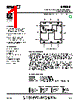
| Description | 2.4GHz TO 2.5GHz, 802.11b/g/n WiFi FRONT END MODULE |


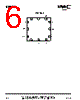

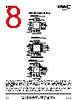
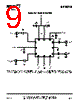
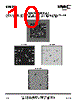


Okay, here's a summary of the information provided in the document, broken down into sections. I'll focus on the key details:
1. Device Overview:
️· The document is a datasheet for the RF5375, a radio frequency (RF) module.
️· It’s designed for wireless communication, likely for applications like Bluetooth, Wi-Fi or similar protocols.
2. Electrical Characteristics & Performance (Based on the graphs):
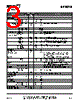
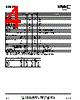
️· Gain/Loss: The document shows graphs of insertion loss and gain across different frequencies.
️· Temperature Dependence: The performance characteristics (gain, loss, harmonic distortion) are shown to vary with temperature (-40°C, +25°C, +70°C). This is crucial for understanding how the module will perform in different environments.
️· Output Power: Performance curves related to output power and distortion (harmonic levels) are displayed. This tells us how efficiently the module transmits and the purity of the signal.
️· Harmonic Performance: Graphs illustrate the levels of 2nd and 3rd harmonic distortion as a function of output power and temperature. Lower harmonic levels mean a cleaner signal.
️· ACP (Adjacent Channel Power): Graphs show ACP1 and ACP2 performance (a measure of signal leakage into adjacent channels) vs. output power and temperature. This is important for minimizing interference.
️· Receiver Insertion Loss: The document demonstrates the receiver insertion loss vs. temperature.
️· Bluetooth Insertion Loss: The document demonstrates the Bluetooth insertion loss vs. temperature.
3. Key Performance Metrics (as can be inferred from graphs):
️· Gain: The module provides a certain amount of signal amplification.
️· Insertion Loss: (for receiver) indicates how much signal is lost when passing through the receiver stage.
️· Distortion (Harmonics & ACP): These metrics show how much unwanted signal is generated during transmission/reception. Lower values are better.
️· Temperature Stability: The graphs show how performance degrades or improves with temperature, which is critical for reliability.
4. Control Voltage:
️· The document mentions a control voltage (High = 3.3V, Low = 0.2V) that is likely used to switch between different modes of operation or to adjust gain/power levels.
In essence, this datasheet provides the engineering data necessary to integrate the RF5375 module into a wireless system and to predict its performance under various conditions. It's geared toward RF engineers and designers.
1. Device Overview:
️· The document is a datasheet for the RF5375, a radio frequency (RF) module.
️· It’s designed for wireless communication, likely for applications like Bluetooth, Wi-Fi or similar protocols.
2. Electrical Characteristics & Performance (Based on the graphs):
️· Gain/Loss: The document shows graphs of insertion loss and gain across different frequencies.
️· Temperature Dependence: The performance characteristics (gain, loss, harmonic distortion) are shown to vary with temperature (-40°C, +25°C, +70°C). This is crucial for understanding how the module will perform in different environments.
️· Output Power: Performance curves related to output power and distortion (harmonic levels) are displayed. This tells us how efficiently the module transmits and the purity of the signal.
️· Harmonic Performance: Graphs illustrate the levels of 2nd and 3rd harmonic distortion as a function of output power and temperature. Lower harmonic levels mean a cleaner signal.
️· ACP (Adjacent Channel Power): Graphs show ACP1 and ACP2 performance (a measure of signal leakage into adjacent channels) vs. output power and temperature. This is important for minimizing interference.
️· Receiver Insertion Loss: The document demonstrates the receiver insertion loss vs. temperature.
️· Bluetooth Insertion Loss: The document demonstrates the Bluetooth insertion loss vs. temperature.
3. Key Performance Metrics (as can be inferred from graphs):
️· Gain: The module provides a certain amount of signal amplification.
️· Insertion Loss: (for receiver) indicates how much signal is lost when passing through the receiver stage.
️· Distortion (Harmonics & ACP): These metrics show how much unwanted signal is generated during transmission/reception. Lower values are better.
️· Temperature Stability: The graphs show how performance degrades or improves with temperature, which is critical for reliability.
4. Control Voltage:
️· The document mentions a control voltage (High = 3.3V, Low = 0.2V) that is likely used to switch between different modes of operation or to adjust gain/power levels.
In essence, this datasheet provides the engineering data necessary to integrate the RF5375 module into a wireless system and to predict its performance under various conditions. It's geared toward RF engineers and designers.
| Part No. | RF5375 |
| Manufacturer | RFMD |
| Size | 1Mb |
| Pages | 12 pages |
| Description | 2.4GHz TO 2.5GHz, 802.11b/g/n WiFi FRONT END MODULE |
| Does ALLDATASHEET help your business so far? [ DONATE ] |
About Alldatasheet | Advertisement | Contact us | Privacy Policy | Link to Datasheet | Link Exchange | Manufacturer List All Rights Reserved©Alldatasheet.com |
| Russian : Alldatasheetru.com | Korean : Alldatasheet.co.kr | Spanish : Alldatasheet.es | French : Alldatasheet.fr | Italian : Alldatasheetit.com Portuguese : Alldatasheetpt.com | Polish : Alldatasheet.pl | Vietnamese : Alldatasheet.vn Indian : Alldatasheet.in | Mexican : Alldatasheet.com.mx | British : Alldatasheet.co.uk | New Zealand : Alldatasheet.co.nz |
|
Family Site : ic2ic.com |
icmetro.com |
 British ▼
  English
 Chinese
 German
 Japanese
 Russian
 Korean
 Spanish
 French
 Italian
 Portuguese
 Polish
 Vietnamese
 Indian
 Mexican
 New Zealand