 |
Electronic Components Datasheet Search |
|
|
Electronic Components Datasheet Search |
|
The question interval is too short.
Please try again in a few seconds.

Hello, Please ask a question about PSC11004 Datasheet
# Example questions:
➢ Describe the auto-tune feature of the psc controller. how does it work, and what parameters does it optimize?
➢ What are the primary functions of configuration 1, and what types of parameters can be adjusted within it?
➢ Explain how these features contribute to process control and safety.
| Part No. | PSC11004 |
| Manufacturer | REDLION |
| Size | 1Mb |
| Pages | 8 pages |
| Description | MODEL PSC - PROCESS SETPOINT CONTROLLER |




PSC Controller: Key Features & Capabilities Summary
1. Core Functionality: Precise Process Control
️· PID Control: The PSC is a PID (Proportional-Integral-Derivative) controller designed for accurate and stable process regulation.
️· Versatile Applications: Suitable for a broad range of applications requiring temperature, flow, level, pressure, or other process variable control.
️· Multiple Output Options: Supports Time Proportional Control, Linear DC Output, and standard ON/OFF control.
2. Input & Display Capabilities
️· Universal Input: Accepts current or voltage signals.
️· Scaling & Linearization: Programmable scaling points allow display in any engineering unit (e.g., °F, PSI, GPM).
️· Input Filtering: Adjustable filtering to reduce noise and stabilize readings.
️· Display Customization: Programmable decimal point position and rounding.
3. Output Features
️· Output Limits: Adjustable high and low output limits for process protection.
️· Signal Overdrive Detection: Detects and responds to signal overdrive conditions.
️· Time Proportional Control: Adjustable cycle time for precise power modulation.
️· Linear DC Output: Provides a DC signal proportional to the process variable or setpoint, enabling slave control loops.
4. Advanced Control & Programming
️· Setpoint Control:
- Ramping: Programmable setpoint ramp rate for smooth transitions.
- Limits: Programmable high and low setpoint limits.
- Multiple Control Points:** Four independent control points with individual setpoints and PID gains for complex processes.
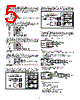
️· Auto-Tune: Automatic PID parameter optimization for simplified setup and optimal performance.
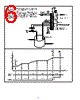
️· Profile Programming:
- Multiple Profiles: Ability to store and execute multiple independent profiles.
- Ramp/Hold Segments: Profiles can be programmed with multiple ramp and hold segments for complex control sequences.
- Programmable Repeat Cycles: Control how many times a profile repeats.
️· Alarm Handling:
- Two Independent Alarms: Configurable alarm operation and reset modes.
- Activation Delay: Programmable delay before alarm activation.
- Hysteresis: Adjustable hysteresis to prevent alarm chatter.
5. Communication & Connectivity
️· RS485 Communication (Optional): Allows remote access to controller parameters and data.
️· Programmable Communication Parameters: Baud rate, parity, and address are configurable.
️· Automatic Printing: Automatic transmission of selected parameters at a programmable rate.
6. Configuration & Programming Modes
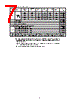
The controller utilizes several configuration modes to customize its behavior. Key configuration sections include:
️· Inputs: Define input type, scaling, and filtering.
️· Outputs: Configure output control action, limits, and cycle time.
️· Parameter Lockouts: Restrict access to specific parameters for security and ease of use.
️· Alarms: Configure alarm operation and setpoints.
️· Secondary Output: Configure the secondary output for linear DC or other applications.
️· Serial Communications: Configure RS485 communication settings.
️· Control Points: Setup and configure the four individual control points.
️· Profiles: Program and manage the control sequences for each of the available profiles.
️· Factory Service Operations: Reserved for advanced troubleshooting and maintenance (details not fully provided).
7. Key Benefits
️· Precise Control: PID algorithm ensures stable and accurate process regulation.
️· Flexibility: Multiple configuration options allow customization for a wide range of applications.
️· Ease of Use: Auto-tune simplifies setup, and programmable profiles streamline complex control sequences.
️· Reliability: Robust design and non-volatile memory ensure long-term stability and data retention.
PSC Controller: Key Features & Capabilities Summary
1. Core Functionality: Precise Process Control
️· PID Control: The PSC is a PID (Proportional-Integral-Derivative) controller designed for accurate and stable process regulation.
️· Versatile Applications: Suitable for a broad range of applications requiring temperature, flow, level, pressure, or other process variable control.
️· Multiple Output Options: Supports Time Proportional Control, Linear DC Output, and standard ON/OFF control.
2. Input & Display Capabilities
️· Universal Input: Accepts current or voltage signals.
️· Scaling & Linearization: Programmable scaling points allow display in any engineering unit (e.g., °F, PSI, GPM).
️· Input Filtering: Adjustable filtering to reduce noise and stabilize readings.
️· Display Customization: Programmable decimal point position and rounding.
3. Output Features
️· Output Limits: Adjustable high and low output limits for process protection.
️· Signal Overdrive Detection: Detects and responds to signal overdrive conditions.
️· Time Proportional Control: Adjustable cycle time for precise power modulation.
️· Linear DC Output: Provides a DC signal proportional to the process variable or setpoint, enabling slave control loops.
4. Advanced Control & Programming
️· Setpoint Control:
- Ramping: Programmable setpoint ramp rate for smooth transitions.
- Limits: Programmable high and low setpoint limits.
- Multiple Control Points:** Four independent control points with individual setpoints and PID gains for complex processes.
️· Auto-Tune: Automatic PID parameter optimization for simplified setup and optimal performance.
️· Profile Programming:
- Multiple Profiles: Ability to store and execute multiple independent profiles.
- Ramp/Hold Segments: Profiles can be programmed with multiple ramp and hold segments for complex control sequences.
- Programmable Repeat Cycles: Control how many times a profile repeats.
️· Alarm Handling:
- Two Independent Alarms: Configurable alarm operation and reset modes.
- Activation Delay: Programmable delay before alarm activation.
- Hysteresis: Adjustable hysteresis to prevent alarm chatter.
5. Communication & Connectivity
️· RS485 Communication (Optional): Allows remote access to controller parameters and data.
️· Programmable Communication Parameters: Baud rate, parity, and address are configurable.
️· Automatic Printing: Automatic transmission of selected parameters at a programmable rate.
6. Configuration & Programming Modes
The controller utilizes several configuration modes to customize its behavior. Key configuration sections include:
️· Inputs: Define input type, scaling, and filtering.
️· Outputs: Configure output control action, limits, and cycle time.
️· Parameter Lockouts: Restrict access to specific parameters for security and ease of use.
️· Alarms: Configure alarm operation and setpoints.
️· Secondary Output: Configure the secondary output for linear DC or other applications.
️· Serial Communications: Configure RS485 communication settings.
️· Control Points: Setup and configure the four individual control points.
️· Profiles: Program and manage the control sequences for each of the available profiles.
️· Factory Service Operations: Reserved for advanced troubleshooting and maintenance (details not fully provided).
7. Key Benefits
️· Precise Control: PID algorithm ensures stable and accurate process regulation.
️· Flexibility: Multiple configuration options allow customization for a wide range of applications.
️· Ease of Use: Auto-tune simplifies setup, and programmable profiles streamline complex control sequences.
️· Reliability: Robust design and non-volatile memory ensure long-term stability and data retention.
| Part No. | PSC11004 |
| Manufacturer | REDLION |
| Size | 1Mb |
| Pages | 8 pages |
| Description | MODEL PSC - PROCESS SETPOINT CONTROLLER |
| Does ALLDATASHEET help your business so far? [ DONATE ] |
About Alldatasheet | Advertisement | Contact us | Privacy Policy | Link to Datasheet | Link Exchange | Manufacturer List All Rights Reserved©Alldatasheet.com |
| Russian : Alldatasheetru.com | Korean : Alldatasheet.co.kr | Spanish : Alldatasheet.es | French : Alldatasheet.fr | Italian : Alldatasheetit.com Portuguese : Alldatasheetpt.com | Polish : Alldatasheet.pl | Vietnamese : Alldatasheet.vn Indian : Alldatasheet.in | Mexican : Alldatasheet.com.mx | British : Alldatasheet.co.uk | New Zealand : Alldatasheet.co.nz |
|
Family Site : ic2ic.com |
icmetro.com |
 British ▼
  English
 Chinese
 German
 Japanese
 Russian
 Korean
 Spanish
 French
 Italian
 Portuguese
 Polish
 Vietnamese
 Indian
 Mexican
 New Zealand